WEATHER · REVIEWED OCTOBER 24, 2026
METAR vs. TAF. Weather made simpler.
One tells you what was observed. The other tells you what is forecast. Start with that difference before decoding the letters.
By Dronezilla · Plain-language education with sources for further reading
Quick facts
A METAR is an observation. A TAF is a forecast. Neither replaces checking the actual conditions at your flight location.
- METAR: An observation at a stated time.
- TAF: A forecast for a stated period.
- TIME: Use the right report and time.
01. Find the station and time.
02. Read the groups in order.
03. Try a simple example.
04. Turn the numbers into a decision.
05. Check your understanding.
METAR + TAF PASS SHEET preview
Identify whether you are reading observed conditions or a forecast. Work through the time, wind, visibility, weather, and cloud groups, then explain the conditions without looking.
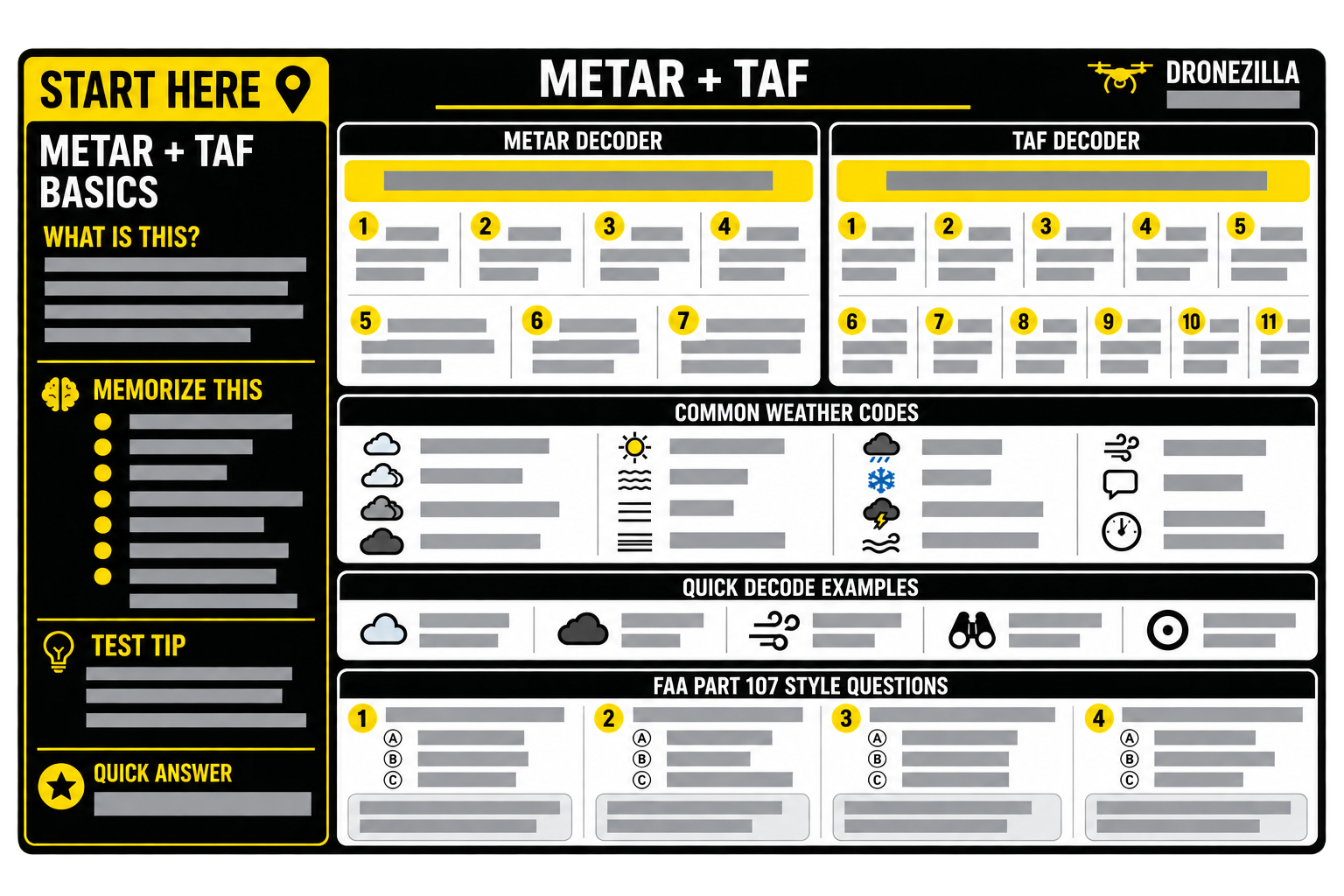
The $49 bundle includes printable PASS SHEETS, mobile flashcard-style PASS SHEETS, Learning Notes, and a poster. Cover a section, recall the concept, and check it. Use mobile review before your exam on test day.
Decode a METAR visually
Practice with an illustrative, invented weather report—not a live observation.
Wind from 180° at 12 knots, gusting to 20.
Visibility of 10 statute miles.
Scattered cloud layer at 2,500 ft AGL.
Broken cloud ceiling at 5,000 ft AGL.
Temperature 22°C and dew point 14°C.
Aviation Weather Center weather-code help · Visibility and cloud clearance.
THE VISUAL STUDY COMPANION
Learn the concepts. Build your review routine.
The $49 Dronezilla PASS SHEETS bundle includes original study sheets, mobile PASS SHEETS, Learning Notes, and a poster. Use the phone-friendly mobile edition for flashcard-style recall, same-day memorization practice, and a test-day refresher before your exam. Four PDFs, one purchase. Pair your review with official FAA references and practice questions.
Explore the $49 bundleTry a free PASS SHEETSources and reference key
Dronezilla is an independent supplemental study resource and is not endorsed by or affiliated with the FAA. Confirm current regulations, chart editions, aircraft instructions, and applicable approvals before relying on any study aid. No exam-pass guarantee.